

Your biggest business risks may not be showing up on financial statements. A business can be profitable, growing, and well respected… yet still have vulnerabilities that quietly limit its future potential.
When something goes wrong, everyone tends to turn to the owner. Critical processes often depend on a single person who knows what to do. Established processes might continue simply because “they’ve always been done that way.” Systems that were fine at $5 million start to break down at $20 million.
None of these issues necessarily shows up as a line item on the income statement, but they can have a real impact on profitability, cash flow, growth, business value, and ultimately, the owner’s ability to step away.
These are the kinds of risks that can be easy to overlook precisely because the business may appear to be doing well. So how can it be fixed?
For privately held and family-owned businesses, risk is not limited to economic downturns, changing markets, or unexpected events. Consequential risks frequently develop inside the business itself.
I believe it can be useful to look at business risk through four practical lenses:
- Cultural Risk — How the organization thinks and adapts
- Structural Risk — Whether systems and processes still fit the business
- Relational Risk — How much the business depends on specific people
- Continuity Risk — How well the business functions through change or disruption
Together, these four forces provide a practical way to identify hidden constraints before they become expensive problems.

Why Look Beyond Traditional Business Risk?
When owners think about risk, they often think about external threats:
- Economic uncertainty
- Supply-chain disruptions
- Labor shortages
- Competition
- Regulation
- Rising interest rates
- Changing customer demand
- Cybersecurity
- Recessions
These definitely matter, but external conditions are only part of the picture.
Consider what happens when a business loses a big customer. Two companies may face the same external event, but they will experience very different outcomes depending on their internal conditions.
- One company has diversified relationships, well-documented processes, strong cash visibility, and a leadership team that can make decisions quickly.
- The other company depends heavily on a handful of customers, has inconsistent processes, operates with limited financial visibility, and depends heavily on its owner to make decisions.
The external risk is the same. The internal capacity to absorb it is not.
Business resilience is not simply about predicting what might happen, it is also about building a business that can respond when something does happen.
The 4 Forces of Business Risk
Think of these 4 forces as areas that influence how well your business can absorb change, maintain performance, and create future options.
They are not necessarily signs that something is wrong. Instead, they are diagnostic lenses we can look through to decide what to adjust. A low level of strength in one area may reveal an opportunity to strengthen the business before that weakness becomes a constraint.
Let’s review each one.
1. Cultural Risk: When Legacy Thinking Limits Forward Progress
All successful businesses has developed a company culture. In many privately held and family-owned companies, that culture is closely connected to the history of the business and reflect its owner’s personality traits, values, and beliefs.

Read more: Understanding the Culture of a Company
Culture can be a tremendous strength because it creates institutional knowledge, customer loyalty, pride, work ethic, and a clear sense of what the company stands for.
The challenge occurs when what worked in the past becomes the default answer for the future.
A business may continue using a process because “That’s the way we’ve always done it.” Sometimes this belief is perfectly reasonable, but it can be a warning sign.

The Hidden Cost of “We’ve Always Done It This Way”
Past success can create what might be called organizational blind spots. Because the same processes, people, workarounds, and inefficiencies are familiar, they stop looking unusual.
A process that takes three unnecessary steps. Delays on making change orders. Invoicing problems that aren’t fixed. Asking managers to approve every request. Spreadsheets that should have been replaced years ago.
None of these feel like a crisis, but collectively they create friction that consumes valuable time, reduces capacity, delays cash flow, and limits potential growth.
Questions to Consider
Ask yourself:
- Which of our long-standing practices are still serving the business?
- How often do we challenge assumptions about how work gets done?
- Can employees suggest improvements without encountering unnecessary resistance?
- Do we adapt when customers expect changes to how we do business?
- Are decisions based primarily on current conditions, or past experience?
The goal is not to throw away tradition, but to preserve the things that create value while questioning what creates friction.
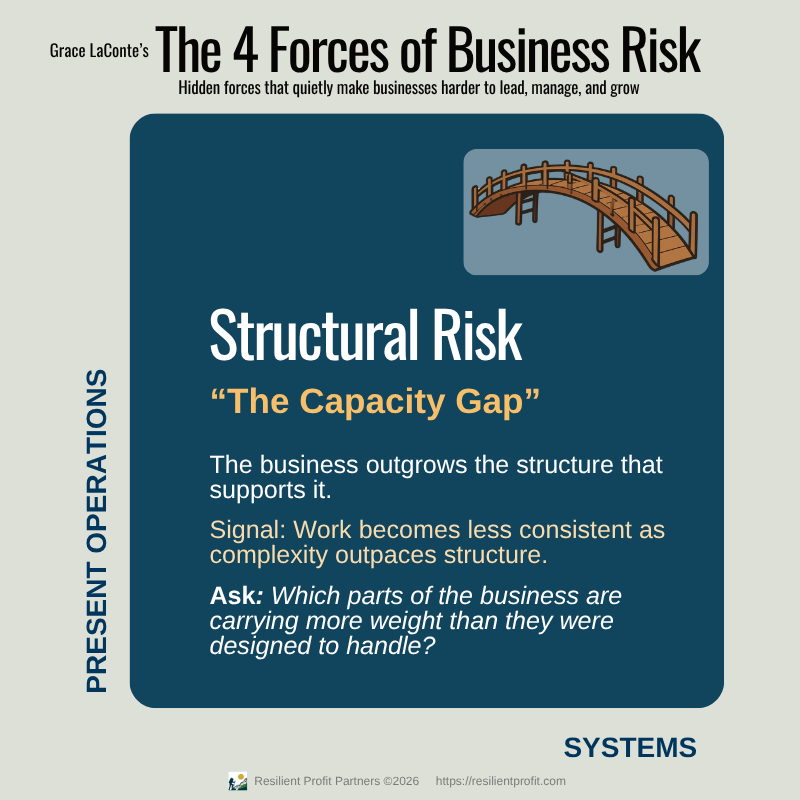
2. Structural Risk: When the Business Outgrows Its Foundation
Growth changes a business, and not all growth is good growth. What worked with 10 employees may not work with 50. What worked with $3 million in revenue may create problems at $15 million. What worked when the owner personally knew every customer, may not work when several layers of management exist.
Yet business leaders often continue operating on structures that were created for an earlier version of the company.
And this creates structural risk.
The Warning Signs Are Often Operational
Structural strain can appear as:
- Repeated workarounds
- Manual processes
- Duplicate data entry
- Inconsistent procedures
- Communication gaps
- Delayed reporting
- Departments using different processes
- Too many approvals
- Poor visibility into key numbers
- Systems that do not communicate effectively
Individually, these may look like small inconveniences. Collectively, they can become profit leaks.
For example, a billing process that requires multiple manual handoffs can create delays. Delayed invoices can slow accounts receivable. Slow collections can increase cash-flow pressure. Cash-flow pressure can limit investment. And limited investment can constrain growth.
The original problem looked like an administrative inconvenience, but the eventual consequence is a strategic vulnerability.
Growth Should Strengthen the Foundation, Not Just Add Weight to It
A useful question is:
Do our systems support the business we have, or the business we used to have?
We can apply this to financial systems, operational processes, technology, organizational structure, communication, and decision-making.
Other Questions to Consider
- Where do employees rely on workarounds?
- Which processes have become unnecessarily complicated?
- What systems are being stretched beyond their original purpose?
- Where does information get lost between departments?
- Are we adding people to compensate for inefficient processes?
The answer is probably not hire another employee, to buy more technology, or to ask everyone to work harder. Instead, leaders can make sure their foundational processes keep pace with the business as it grows.
3. Relational Risk: When Too Much Depends on Too Few People
People are the greatest assets to a privately held business. Your staff can become a source of valuable information, because they are very familiar with hidden risks. critical knowledge, interpersonal relationships, and areas where decisions are concentrated in too few individuals.
Consider what happens when:
- One salesperson holds onto a major customer relationship.
- One employee knows how a critical machine operates.
- One manager understands the entire production schedule.
- One person knows how to resolve a recurring billing issue.
- One executive approves nearly every important decision.
- One CFO is the only person who understands the full financial picture.
The business may appear to be operating smoothly, but smooth operation can hide concentration risk.

The “Key Person” Test
Ask yourself:
If this key person disappeared from the business tomorrow, what would stop working?
The answer may reveal more than an organizational chart ever could. Relational risk is not about replacing valuable people, it is about making sure the business does not become held hostage by its own expertise. Strong organizations are able to turn individual knowledge into organizational capability.
That means:
- Sharing knowledge
- Cross-training
- Asking for honest feedback
- Documenting critical processes
- Developing decision-making capability
- Building multiple customer relationships
- Creating clear accountability
- Developing the next generation of leaders
The objective is to make the business stronger because of its people, rather than vulnerable because of them.

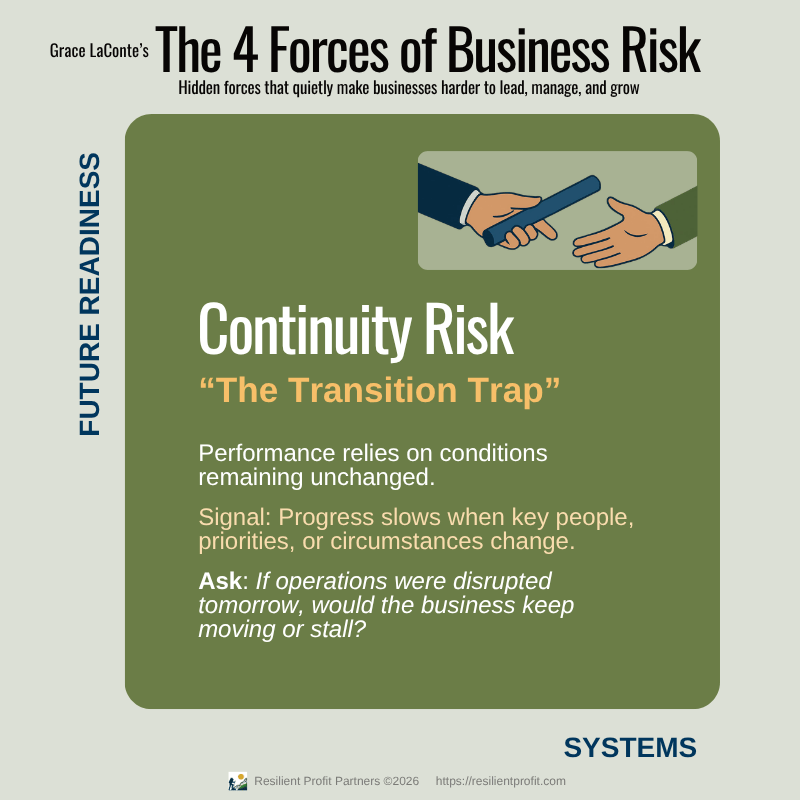
4. Continuity Risk: When the Business Cannot Easily Operate Without Its Key People
Imagine that tomorrow morning you cannot come to work. Not forever, just for 30 days.
Could the business continue operating effectively?
That simple question can reveal a surprising amount about the strength of a company’s operating model. For many privately held businesses, the owner is deeply involved in:
- Major customer relationships
- Pricing decisions
- Approvals
- Vendor negotiations
- Cash management
- Problem solving
- Hiring
- Employee issues
- Strategic decisions
- Institutional knowledge
Although the owner’s involvement may have been essential when the company was smaller, as the company grows this dependency can become a significant constraint.
Growth Can Increase Dependency
A business can become larger without becoming less dependent on its owner. In fact, growth can sometimes increase complexity and create more decisions that flow back to the same person.

Read more about Strategic Growth here.
The result is a paradox:
The business grows, but the owner’s freedom does not.
That extends beyond lifestyle or financial realities. Owner dependency can affect:
- Operational continuity
- Employee confidence
- Customer relationships
- Succession readiness
- Business valuation
- The owner’s ability to take time off
- The company’s response to unexpected events
A business that requires the owner to keep everything moving may be profitable, but it may not yet be as resilient or transferable as the owner believes.
Questions to Consider
- What happens if a key leader is unavailable for 30 days?
- Which responsibilities exist only because someone remembers how to perform them?
- Are all critical processes clearly documented?
- Do multiple people understand essential functions?
- Can the team make important decisions without waiting for the owner?
Continuity does not mean having a giant binder of procedures; it is about making sure the business has enough clarity, capability, and redundancy to keep moving forward.
The Four Forces Work Together
These risks rarely operate independently; they often reinforce one another. For example:
Cultural Risk
“We have always handled it this way.”
↓
Structural Risk
The process becomes increasingly inefficient.
↓
Relational Risk
One experienced employee becomes the only person who knows how to navigate the process.
↓
Continuity Risk
If that person leaves, operations slow down.
↓
Profit Impact
Delays, errors, rework, missed opportunities, and slower cash flow begin to affect profitability.
Cultural Risk → Structural Risk → Relational Risk → Continuity Risk → Profit Impact
What started as a cultural habit eventually became a financial problem. And that’s why looking at business risk through a single lens can cause us to miss the bigger picture.
Where is the business stronger than it needs to be, and where is it more vulnerable than it appears?
Questions Worth Asking Your Leadership Team
Take these concepts and turn them into concrete decisions. Ask yourself:
1. What happens if our owner is unavailable for 30 days?
You don’t need to ask whether people think they could manage. Identify specifically what would stop, slow down, or require outside intervention.
2. Where do we rely on workarounds?
Workarounds are often evidence that the official process no longer matches reality.
3. What does only one person know?
Make a list, then determine which knowledge would create significant disruption if that person were unavailable.
4. Where are we losing time, cash, or capacity without realizing it?
Look beyond obvious expenses. Consider delayed billing, rework, errors, slow approvals, idle capacity, poor communication, customer churn, and management time.
5. What worked 5 years ago that may no longer fit today?
By asking this question, you can uncover both structural and cultural constraints.
From Risk Identification to Resilient Profit
Identifying risk is not the end goal. The goal is to create a stronger business. That means moving from:
Hidden Risk → Visibility → Action → Stronger Performance
A business becomes more resilient when its owner can see what is happening, understand what is driving it, and act before a small constraint becomes a major problem. This is especially important when the goal is not simply to grow revenue.
A stronger business should ideally create:
- More predictable cash flow
- Healthier profit margins
- Greater operational stability
- Less dependence on the owner
- Stronger leadership capability
- Greater business value
- More options for the future
That is the difference between simply managing risk and building resilient profit.

Read more: Mastering Profit Optimization: How to Plug Leaks, Eliminate Blockages, and Unlock Predictable Growth
The Goal Is Not a Risk-Free Business
There is no such thing as a business that has no risk, and trying to eliminate all risks would result in a business that is too rigid to operate effectively.
A better goal is to identify areas where your business is vulnerable, determine which vulnerabilities are most harmful, and strengthen the areas that can have the greatest impact. For privately held and family-owned businesses, this can be especially important because the business often represents much more than an income stream.
It may represent decades of work, a family legacy, employees’ livelihoods, meaningful customer relationships, community reputation, and a significant portion of the owner’s personal wealth and hard work. That makes business strength more than an operational issue; it is an ownership issue.
Conclusion: Build a Business That Can Carry Its Own Weight
A successful business can still have hidden weaknesses:
- Cultural habits that limit adaptation.
- Continuity gaps that lead to fragility.
- Structural weaknesses that make growth harder than it needs to be.
- Relational dependencies that make it overly dependent on a few people.
None of these forces necessarily creates an immediate crisis, and that is precisely why they should be addressed. The most effective business owners don’t wait for a problem to become painful before they examine its root cause. They can step back and look at the problem objectively, identify what is working, uncover what is creating friction, and strengthen the foundation before another challenge arrives.
Ultimately, a measure of business strength is not “How well is the business performing today?”
It is “How well is the business positioned to perform when conditions change?”
This is where resilience becomes a source of profit, value, and freedom.
Take the Next Step
Ready to take a closer look? If you’d like to identify your business may be harder to run, schedule an initial conversation. We can explore your priorities and clarify areas where a more objective look could create meaningful results.
Grace LaConte

Grace LaConte is a Decision & Continuity Advisor who helps independent owners in manufacturing, B2B, and professional services to uncover hidden profit leaks and build stronger companies without burnout or added complexity. She uses proven frameworks and data-driven insights to improve cash flow, boost margins, and create lasting value. When not consulting, she develops practical tools that help owners protect their bottom line and grow businesses that last.